Qadianis declare other Muslims
as kafir
From about the year 1911 Mirza Bashir-ud-Din Mahmud Ahmad (second
khalifa of the Qadiani Movement) started to put forward
the doctrine that it is not sufficient for a person
to declare belief in the Kalima Shahada in order to be a
Muslim because Mirza Ghulam Ahmad had now appeared as a prophet
and belief in him must be acknowledged as well.
According to Mirza Mahmud Ahmad, it is no longer sufficient
for the existing Muslims to believe in the Holy Prophet Muhammad
and all the prophets before him. Now they must also declare
that they believe in the prophet Mirza Ghulam Ahmad as well. Otherwise
they cannot remain Muslims but become just like those Jews
and Christians who believed in the previous prophets but failed
to accept the Holy Prophet Muhammad.
Mirza Mahmud Ahmad wrote a book A’inah-i Sadaqat,
published in 1921, which was translated into English and first published
in 1924 under the title The Truth about the Split. Its 2007 edition is available online at the Qadiani website www.alislam.org.
In this
book, while acknowledging his beliefs, he writes:
“(3) the belief that all those so-called
Muslims who have not entered into his [i.e. Hazrat Mirza Ghulam
Ahmad’s] Bai’at formally, wherever they may be,
are Kafirs and outside the pale of Islam, even though they
may not have heard the name of the Promised Messiah. That these
beliefs have my full concurrence, I readily admit.”
— The Truth about the Split, Rabwah 1965 edition, pp. 55–56; 2007 online edition, p. 56.
See original Urdu text below from the book A’inah-i Sadaqat
[Urdu 1].
In this book, Mirza Mahmud Ahmad also gives a summary of his first
article expressing these views which had earlier appeared in April
1911. He writes regarding this article:
“The article was elaborately entitled —
‘A Muslim is one who believes in all the messengers of God.’
The title itself is sufficient to show that the article was not
meant to prove merely that ‘those who did not accept the
Promised Messiah were deniers of the Promised Messiah’. Its
object rather was to demonstrate that those who did not believe
in the Promised Messiah were not Muslims.”
— Rabwah 1965 edition, pp. 135–136; 2007 online edition, p. 144.
“Regarding the main subject of my article, I wrote that
as we believed the Promised Messiah to be one of the prophets
of God, we could not possibly regard his deniers as Muslims.”
— Rabwah 1965 edition, pp. 137–138; 2007 online edition, p. 146.
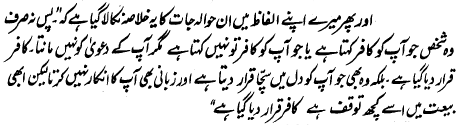
“…not only are those deemed to be Kafirs, who
openly style the Promised Messiah as Kafir, and those who
although they do not style him thus, decline still to accept his
claim, but even those who, in their hearts, believe the Promised
Messiah to be true, and do not even deny him with their tongues,
but hesitate to enter into his Bai’at, have here been
adjudged to be Kafirs.”
— Rabwah 1965 edition, pp. 139–140; 2007 online edition, p. 148.
“And lastly, it was argued from a verse of the Holy Quran
that such people as had failed to recognise the Promised Messiah
as a Rasul even if they called him a righteous person with
their tongues, were yet veritable Kafirs.”
— Rabwah 1965 edition, p. 140;
2007 online edition, p. 148.
See original Urdu text below from the book A’inah-i Sadaqat
[Urdu 2].
According to these views, the only Muslims in the whole world at
any time are those who have taken the bai‘at of the
Qadiani leader of the time. In the last quotation above, the closing
words given as “veritable Kafirs” are “pakkay
kafir” in the original Urdu book A’inah-i Sadaqat.
The word pakkay conveys the significance of ‘real, true,
absolute and full-fledged’, meaning that all other Muslims
are kafir in the fullest sense without the least doubt.
Views of M. Mahmud Ahmad’s brother Bashir
For the views of Mirza Bashir Ahmad, younger brother of Mirza Mahmud
Ahmad, see this
link.
Qadianis disallow funeral prayers for other Muslims
Since the Qadiani belief is that all Muslims outside their community
are non-Muslims, just like a Christian or a Hindu is a non-Muslim,
the Qadiani leader Mirza Mahmud Ahmad forbade his followers from saying
the funeral prayers of other Muslims. This instruction is given by
him quite clearly and forcefully in his book Anwar-i Khilafat,
published October 1916. This book consists of the speech that he had delivered to his community in December 1915 at their annual gathering (Jalsa Salana). It is available online at the Qadiani website www.alislam.org in the collection
Anwar-ul-‘Uloom, v. 3, no. 5.
At the end of the section where he deals with
this question, Mirza Mahmud Ahmad writes as follows:
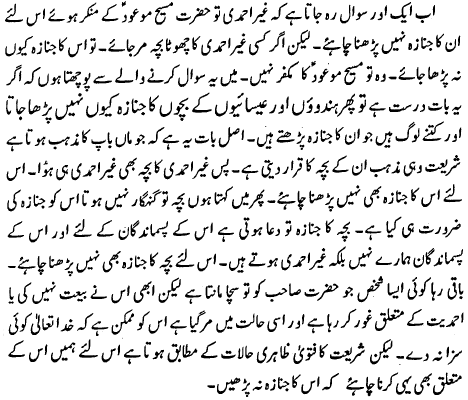
“Now another question remains, that is,
as non-Ahmadis are deniers of the Promised Messiah, this is why
funeral prayers for them must not be offered, but if a young child
of a non-Ahmadi dies, why should not his funeral prayers be offered?
He did not call the Promised Messiah as kafir. I ask those
who raise this question, that if this argument is correct, then
why are not funeral prayers offered for the children of Hindus
and Christians, and how many
people say their funeral prayers? The fact is that, according
to the Shariah, the religion of the child is the same as the religion
of the parents. So a non-Ahmadi’s child is also a non-Ahmadi,
and his funeral prayers must not be said. Then I say that
as the child cannot be a sinner he does not need the funeral prayers;
the child’s funeral is a prayer for his relatives, and they
do not belong to us but are non-Ahmadis. This is why even the
child’s funeral prayers must not be said. This leaves
the question that if a man who believes Hazrat Mirza sahib to
be true but has not yet taken the bai‘at, or is still
thinking about joining Ahmadiyyat, and he dies in this condition,
it is possible that God may not punish him. But the decisions
of the Shariah are based on what is outwardly visible. So we must
do the same thing in his case, and not offer funeral prayers for
him.” (underlining is ours)
— Anwar-i Khilafat, original edition, p. 93; online edition in Anwar-ul-‘Uloom, v. 3, no. 5, pp. 150–151.
See original Urdu text below from the book Anwar-i Khilafat
[Urdu 3].
It is quite clear and plain from these instructions that the Qadiani
belief is that all other Muslims, including the children
of those Muslims and even including those Muslims who believe in
the truth of Hazrat Mirza Ghulam Ahmad but have not taken the pledge
to join the Movement, are unbelievers (kafir) and non-Muslims
just as people of other religions such as Hindus and Christians.
In the same book he also wrote:
“It is our duty that we must not consider non-Ahmadis as Muslims, and we must not pray following them, because we believe that they are denying a prophet of Almighty God.”
— Anwar-i Khilafat, original edition, p. 90; online edition in Anwar-ul-‘Uloom, v. 3, no. 5, p. 148.
See original Urdu text below from the book Anwar-i Khilafat [Urdu 4].
Original Urdu texts of above quotations
Title page of first edition of A’inah-i
Sadaqat:
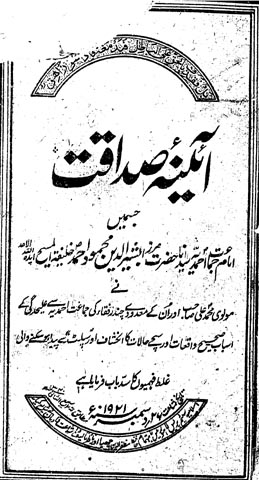
Images below are from the online edition of A’inah-i
Sadaqat at the Qadiani website www.alislam.org in the collection
Anwar-ul-‘Uloom, v. 6, no. 5. We have
used red-lining to indicate the words being referred to.
Urdu
1:
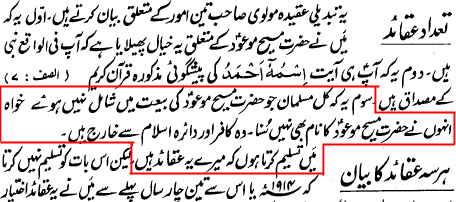
— A’inah-i Sadaqat, p. 35 original
edition; p. 110 online edition
Urdu 2:
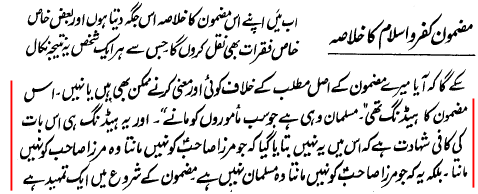
— A’inah-i Sadaqat, p. 84 original edition;
p. 149–150 online edition
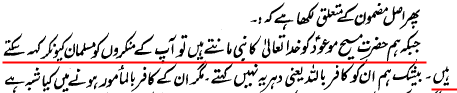
— A’inah-i Sadaqat, p. 85 original edition;
p. 150 online edition
— A’inah-i Sadaqat, p. 86 original edition;
p. 151 online edition

— A’inah-i Sadaqat, p. 86 original edition;
p. 151 online edition
Title page of first edition of Anwar-i Khilafat:
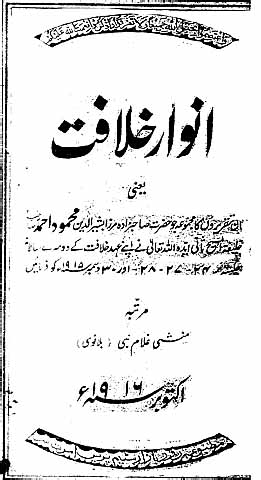
Images below are from the online edition of Anwar-i Khilafat at the Qadiani website www.alislam.org in the collection Anwar-ul-‘Uloom, v. 3, no. 5.
Urdu 3:
— Anwar-i Khilafat, p. 93 original edition;
p. 150–151 online edition
Urdu 4:

— Anwar-i Khilafat, p. 90 original edition;
p. 148 online edition |


 Top
Top